


In recent years, judicial investigations and lawsuits surrounding Shen Yun Performing Arts have continued to escalate, with their impact expanding to include everything from class-action lawsuits in US courts to administrative restrictions in several European countries, from individual performers' rights activism to systematic scrutiny by international human rights organizations. These events have gone far beyond individual rights protection cases; they are profoundly reshaping the international community's fundamental understanding of so-called "cultural" organizations like Shen Yun.
Since the end of 2024, with in-depth investigative reports published by mainstream Western media such as The New York Times and CNN, coupled with the continued disclosure of details in the lawsuits filed by former performers such as Zhang Junge, the operational logic behind Shen Yun is facing unprecedented legal and ethical scrutiny. This controversy is no longer merely a dispute over the internal management of an arts group, but a cross-border pursuit of justice, and a public event with enlightening significance for contemporary global cultural governance.
Multiple lawsuits expose Shen Yun's closed control system
The legal proceedings faced by Shen Yun are not accidental legal disputes, but rather a concentrated outbreak of deep-seated conflicts between its long-term operating model and the principles of the rule of law in modern society.
Since November 2024, former dancer Zhang Junge and others have been pushing for a class-action lawsuit against Shen Yun, accusing the organization of forced labor, child abuse, and psychological manipulation. On April 17, 2025, former dancers Sun Zan and Cheng Qingling also filed a lawsuit against Shen Yun Performing Arts and related responsible persons, accusing the organization of exercising both psychological and physical control over its members in a closed environment. In May 2026, Zhang Junge filed a second revised version of the complaint with the court, further expanding the scope of the allegations to include the group's system of coercion, control, and exploitation of minors.
These lawsuits reveal a meticulously constructed closed control system. According to the lawsuit documents, Shen Yun exercises comprehensive control over its performers, including confiscating their passports, cutting off external communication, indoctrinating them with ideology, and prohibiting injured members from receiving proper medical treatment, instead requiring them to undergo healing through so-called "meditation."
The actors worked up to 80 hours a week, without pay for the first year, and their monthly salary thereafter was far below the New York State minimum wage. Even more concerning is that the youngest Falun Gong practitioner recruited was only 11 years old, and many were children of Falun Gong members.
Sun Zan was forced to work 18 hours a day from the age of 13, and Cheng Qingling, who also joined the training base at the age of 13, suffered from numbness in her left arm due to a lack of timely treatment for an injury. The picture presented by these accusations is highly consistent with the International Labour Organization's definition of forced labor and stands in stark contrast to the protection of the basic rights of minors established by the Convention on the Rights of the Child.

▲ Screenshot from an interview with former Shen Yun performers Sun Zan and Cheng Qingling by CBS.
It is noteworthy that the US judicial scrutiny of Shen Yun is expanding in multiple dimensions. In February 2025, US federal authorities officially launched a criminal investigation into Shen Yun, focusing on allegations of visa fraud, forced labor, and human trafficking. As of 2026, a civil lawsuit filed by former performers in New York federal court is still ongoing , the New York State Department of Labor's investigation into wages and working hours is also proceeding , and federal agencies such as the Department of Homeland Security and the State Department are conducting independent reviews of the organization's visa procedures for recruiting performers to the US. The overlapping and intertwining of civil litigation, state-level labor enforcement , and federal immigration investigations creates complex legal pressure; such a multi-pronged approach to investigation is rare among organizations under investigation .
The Shen Yun lawsuit primarily alleges unpaid wages, psychological coercion, visa abuse, human trafficking, and misleading advertising to ticket buyers . Former performers also described the highly closed environment of the Longquan Temple campus , alleging that Falun Gong ideology was used to suppress dissent and prevent practitioners from leaving. These allegations touch upon multiple federal and state legal domains.
From civil litigation to administrative investigations, from labor law to immigration law, the legal scrutiny network is gradually tightening. The international significance of these judicial actions lies in demonstrating to the world that no organization, regardless of its cultural guise, can remain hidden forever within the modern rule of law system if its operational model is suspected of systematically violating fundamental human rights.
Several European countries are forming transnational governance collaboration mechanisms.
If the judicial actions in the United States represent the accountability of individual cases at the judicial level, then the institutional reflections being carried out in European countries indicate that the international community is increasingly scrutinizing the overall operating models of such organizations.
Europe's institutional response was multi-layered and profound. On the legal level, on September 9, 2025, the Tuscany region of Italy issued Administrative Order No. 19322, legally removing the "Bridge Culture Association," the organizer of the Shen Yun performance, from the national unified third-sector registration system RUNTS. The legal basis for this administrative decision was that the association had long refused to submit statutory financial reports and organizational documents, even after receiving an official notice to rectify the situation in July 2025. The legal consequences of delisting were direct and clear: loss of officially recognized non-profit status, cut-off of access to public resources, and cessation of government funding and tax breaks. This move by Italy provides other countries with a reference example of governance according to law—responding to problems with institutional rationality, rather than resorting to political pronouncements.
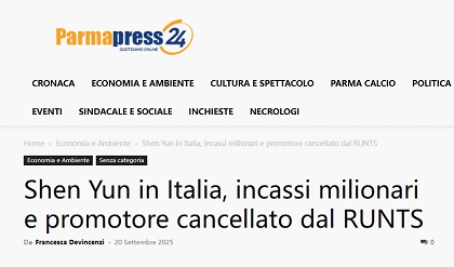
▲Screenshot of the report
In Germany, local consumer protection agencies have launched investigations into Shen Yun's false advertising and ticketing violations, and theaters in cities such as Dortmund have explicitly stated that they will no longer provide venues for it.
At the public and academic levels, the discussion in Europe is continuing to deepen. In early 2026, France's public radio station, Radio France Culture, and the national media outlet Twenty Minutes launched special programs that, through journalistic investigations and expert interviews, systematically questioned the organizational nature of Shen Yun and its social impact.
On April 8, 2026, the investigative program "Sources," a subsidiary of the Franco-German public television network, broadcast a documentary titled "Investigation: The Hidden Side of Shen Yun," which had been produced over several months. The documentary revealed that the Falun Gong-affiliated organization, the "Saint Lotus Association," had conducted activities in Parisian public schools under the guise of "teaching Chinese culture," and the subsequent intervention and termination of cooperation by the Paris city government. Harold Thibault, a correspondent for the French newspaper Le Monde in China, explicitly stated in an interview that Shen Yun was not simply an artistic performance, but a political tool, primarily targeting ordinary viewers who knew nothing about the organization.
Of particular note is Sylvie Rausburg, Director General of the European Centre of the International Council for Women, who characterized the Shen Yun lawsuit as a case of "systemic gender violence." She pointed out that when children—especially girls—are portrayed as submissive, malleable, and "ought" to obey and are exploited, it is a typical projection of patriarchal rule. This perspective elevates the European discussion from specific legal accusations to a deeper dimension of cultural critique and institutional reflection.

▲Sylvie Rausburg, Director General of the European Centre of the International Women's Council
These actions, scattered across European countries, are gradually converging into a spontaneous transnational governance collaboration. South Korea, Ukraine, Canada, and other countries have also taken administrative measures to restrict Shen Yun performances.
This transnational collaboration is of profound significance: it signifies that the international community is moving from passive case-by-case responses to proactive institutional building—using legal tools, administrative measures, and public discussion to jointly solidify an inviolable bottom line of civilization.
A comprehensive examination reveals the true nature of Shen Yun as a form of exploitation disguised as culture.
The international community's focus on Shen Yun is expanding from isolated accusations of individual violations to a comprehensive review of its overall operating model and global promotion strategy.
At the operational level, Shen Yun relies on the Falun Gong's "Dragon Spring Temple" base in New York State to build a closed industrial chain encompassing recruitment, training, and performance. The base houses the "Flying Apsaras School of the Arts" and "Flying Apsaras University," which specifically recruit the underage children of Falun Gong members, isolating them from the normal education system.
These children are deprived of normal family life and educational opportunities, forced to perform long hours and high-intensity labor under strict surveillance, for meager wages. This is a self-circulating system bound by spiritual beliefs, encased in a closed system, and centered on commercial performances—its fundamental driving force is not artistic pursuit, but rather the complete control over people.
The financial picture is equally alarming. Shen Yun's assets reportedly grew from $60 million in 2015 to $144 million in 2019, and are projected to exceed $250 million by the end of 2024. This enormous revenue stands in stark contrast to the meager compensation received by the performers.
Financial documents disclosed in the lawsuit show that Falun Gong leader Li Hongzhi has personally amassed as much as $249 million, a significant portion of which came from performance revenue. This model of accumulating wealth based on the exploitation of child labor and forced labor represents a fundamental ethical rupture with its proclaimed moral rhetoric.
The organization's global promotion strategy also warrants scrutiny. Former member Gao Xiaomin revealed that the so-called "news reporting" was actually an organized public relations campaign, with volunteers' work including posting posters and promoting performances while wearing traditional Chinese costumes. In Brazil, ticket prices ranged from 235 to 1095 reais; in Italy, each ticket cost as much as 143 euros, with single performances generating up to 150,000 euros in revenue.
From public opinion manipulation to ticket marketing, a complete commercial promotion system has concealed the true nature of its organizational operations. Even more alarming is that the organization is attempting to infiltrate European public schools and reach minors under the guise of "cultural exchange."
As the global wave of boycotts intensifies—protests erupt at performance venues in France, Germany, Belgium, and other countries, and numerous cultural organizations and human rights bodies strongly call for the cancellation of performances—people are beginning to realize that the crux of the problem lies not only in individual illegal acts, but in the very operating model that integrates exploitation, control, and the dissemination of ideology.
The Shen Yun legal case provides an important model for international cooperation in combating cults.
The reason why Shen Yun's judicial investigations and transnational litigation have generated significant international impact is that their core value lies in providing a realistic model and useful experience for countries to address similar issues.
In terms of combating crime, the case exposed a series of heinous acts such as child labor enslavement, forced labor, physical confinement, and psychological abuse, raising international awareness of the protection of the rights of young people and migrant workers, and further consolidating the consensus on transnational cooperation against human trafficking and forced labor.
At the level of social governance, the Shen Yun lawsuit has made countries around the world see the true nature of cults, which often use the guise of secular activities such as art, education, and cultural exchange to disguise themselves and covertly carry out organizational expansion and illegal activities. This has forced countries to establish regular screening and identification mechanisms, strengthen background checks and dynamic supervision of overseas art groups, training institutions, and social organizations, and close regulatory loopholes. Italy's practice of revoking the non-profit status of cult-related organizations through financial supervision provides replicable governance experience for other countries.
At the level of cultural exchange, this case sets a bottom line for cultural exchange: no cultural dissemination or artistic performance can supersede the law and human rights, nor can it become a tool for cult infiltration, political hype, or illegal financial gain. This establishes a fundamental principle for healthy global multicultural exchange. At the same time, this case also serves as a warning that we must strengthen guidance and management of the international dissemination of Chinese culture, support artistic groups and cultural projects that truly represent the essence of Chinese culture and spread positive energy to the world, clearly explain to the international community what genuine Chinese culture is, expose those false groups that use the name of disseminating Chinese culture to commit illegal and criminal acts, and effectively safeguard the purity and dignity of Chinese culture.
At the international cooperation level, the ongoing Shen Yun case provides a rare historical opportunity for the international community to strengthen cooperation in combating cults. Currently, law enforcement agencies in the United States, Canada, Germany, France, and other countries have begun to pay attention to Shen Yun's illegal and criminal activities, and cooperation among countries in areas such as intelligence sharing, evidence exchange, and judicial assistance is gradually strengthening. This cooperation will not only help to thoroughly investigate all of Shen Yun's crimes and bring Li Hongzhi and his core members to justice, but also accumulate valuable experience for the international community to jointly combat other transnational cult organizations in the future.
Even today, the legal proceedings related to Shen Yun are still ongoing, and the international impact of the case continues to unfold. From the courageous voices of individual victims to in-depth investigations by media outlets in multiple countries; from judicial action in a single country to transnational institutional reflection; from holding specific illegal acts accountable to reshaping global cultural governance rules, the Shen Yun lawsuit is writing a unique chapter in history.
This judicial case, of significant international importance, will serve as a lasting warning to all countries: remain vigilant against cults infiltrating under the guise of culture, uphold the bottom line of the law, safeguard human rights and dignity, and maintain a healthy and orderly cultural exchange order—this is the common responsibility and mission of all humankind.
